Barking Up the Right Tree With K9 Security Patrols
When people think about security guards, they usually picture someone standing at a gate, walking around a property or watching CCTV screens. That is still a big part of the security industry, but some businesses need something more.
This is where K9 security patrols come in.
Security dogs have been used for decades in different environments, from warehouses and construction sites to industrial properties and large private premises. In the US and UK, trained security dogs can be used alongside professional handlers to provide an additional layer of protection.
The idea is fairly simple: a trained dog can notice movement, sounds and scents that a person might not immediately pick up on. The handler then decides how to respond safely and appropriately.
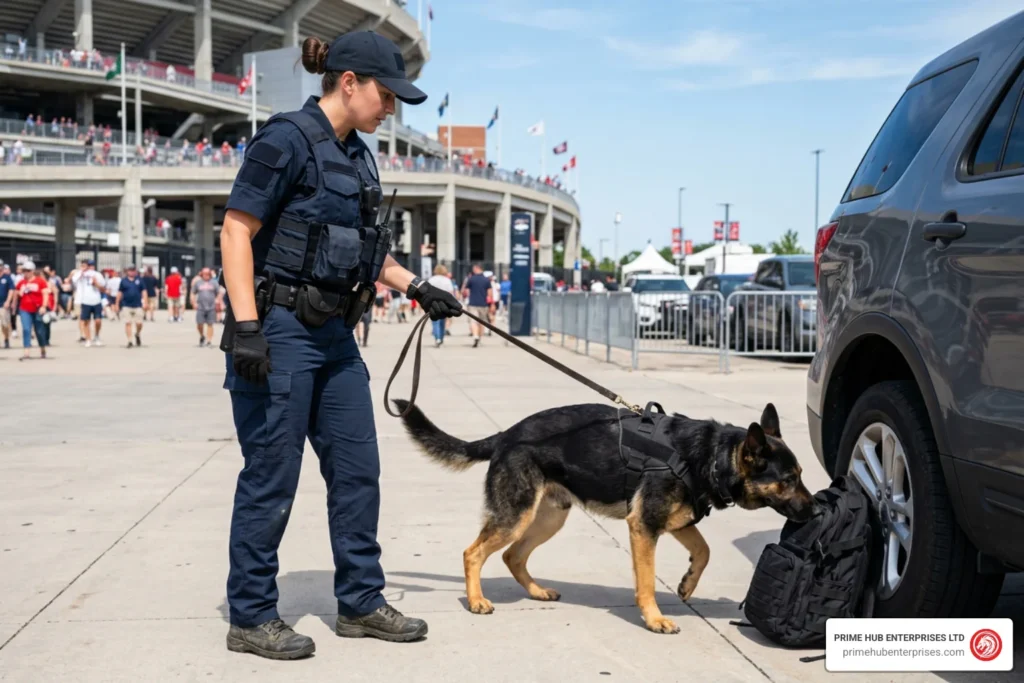
What Is a K9 Security Patrol?
A K9 security patrol normally involves a trained security dog working with a qualified handler.
The pair may patrol a property, check specific areas or respond to unusual activity. Depending on the service and local requirements, K9 teams can be used for deterrence, patrol work, detection and other specialist security tasks.
They can be particularly useful on large sites where a single person may struggle to monitor every area effectively.
Construction sites, warehouses, industrial estates, vacant properties and event locations are examples of places where businesses may consider this type of security.
Why Businesses Use Security Dogs
One of the main reasons is deterrence.
A visible K9 patrol can make a property less attractive to someone looking for an easy opportunity to trespass or steal equipment. A dog also adds another sense to the security process.
For example, a handler walking through a quiet warehouse at night may notice that the dog has reacted to something before there is any obvious visual indication of a problem.
That does not mean a security dog replaces cameras, alarms or other systems. In many situations, the most practical approach is to combine several layers of security.
K9 Security for Construction Sites
Construction sites can be difficult to secure.
There may be expensive tools, machinery, fuel, building materials and equipment spread across a relatively large area. Sites can also have multiple access points and areas that are not occupied outside working hours.
A K9 patrol can provide a physical security presence during the hours when the site is closed.
Regular patrols can also make it harder for an intruder to predict exactly where a security team will be at a particular moment.
Warehouse and Industrial Security
Warehouses often contain valuable inventory, electronics, machinery or other commercial goods.
Large industrial properties can present another challenge: their size.
A security team may need to cover loading areas, entrances, perimeter fencing, storage areas and vehicle access points. K9 patrols can be incorporated into those existing security arrangements where appropriate.
Businesses can also combine patrols with CCTV and access-control systems, allowing security staff to respond to information from several sources rather than relying on a single method.
K9 Security in the UK
The UK has a well-established private security industry, and businesses using security personnel need to pay attention to the applicable rules and licensing requirements.
Anyone considering a K9 security provider should check that the company and handlers meet the relevant legal and industry requirements for the work being carried out.
This is especially important because not every company advertising security services necessarily provides the same level of training, insurance or professional oversight.
A business should ask questions about handler qualifications, dog training, insurance, incident procedures and the exact services included in the contract.
K9 Security in the United States
The US security market is large and varies considerably from one state to another.
Rules surrounding private security personnel, armed services, dogs and specific types of security work can differ depending on the state and sometimes the local jurisdiction.
For that reason, a business should not assume that a security arrangement that is acceptable in one state automatically meets the requirements somewhere else.
Before hiring a K9 security company, property owners should confirm that the provider operates legally in their area and carries appropriate insurance.
What Makes a Good K9 Security Team?
The dog is only one part of the equation.
The handler is equally important.
A professional handler needs to understand the dog’s behaviour, maintain control and know how to respond when the dog detects something unusual. Regular training is also important because security work requires consistency rather than simply having a large or intimidating dog.
When comparing providers, businesses can ask about:
- Handler training
- Dog training and certification
- Experience with similar properties
- Insurance coverage
- Patrol procedures
- Incident reporting
- Emergency response arrangements
- Animal welfare practices
- Local licensing requirements
A reputable provider should be able to explain its procedures clearly.
How Much Does K9 Security Cost?
The price depends on several factors.
A small site requiring occasional patrols will normally have different requirements from a large industrial property needing regular overnight coverage.
Cost can be influenced by:
- Number of patrol hours
- Site size
- Patrol frequency
- Location
- Number of security teams required
- Type of security work
- Contract length
- Additional services
Businesses should compare the actual service being provided rather than choosing a company solely because it offers the lowest hourly rate.
K9 Patrols and Modern Security Technology
There is no reason for traditional security and technology to compete with each other.
In fact, they can work together.
CCTV can monitor entrances and other areas continuously. Motion sensors can identify unusual activity. Access-control systems can restrict who enters a property. A K9 handler can then provide a physical response and investigate areas that require attention.
This layered approach can be particularly useful for larger commercial properties.
Choosing a K9 Security Provider
Before signing a contract, ask the provider exactly what the patrol includes.
Will the team patrol the perimeter? Are interior checks included? How often will the site be visited? What happens if the handler discovers suspicious activity?
It is also worth asking how incidents are documented and who receives the reports.
References from businesses with similar security requirements can be useful as well.
Most importantly, the company should be able to explain its approach without making unrealistic promises. Professional security is about managing risk, not claiming that one service can prevent every possible incident.
Final Thoughts
K9 security patrols can give businesses another useful layer of protection, particularly at large or difficult-to-monitor properties.
The biggest benefit is not simply having a security dog on site. It is the combination of a properly trained dog, an experienced handler, clear procedures and other security measures such as CCTV, alarms and access control.
For businesses in the US and UK considering K9 security, the sensible starting point is to identify the property’s actual risks and then find a provider with the appropriate training, insurance, experience and local compliance.
When the right team is matched with the right environment, K9 patrols can become a practical part of a broader commercial security strategy.